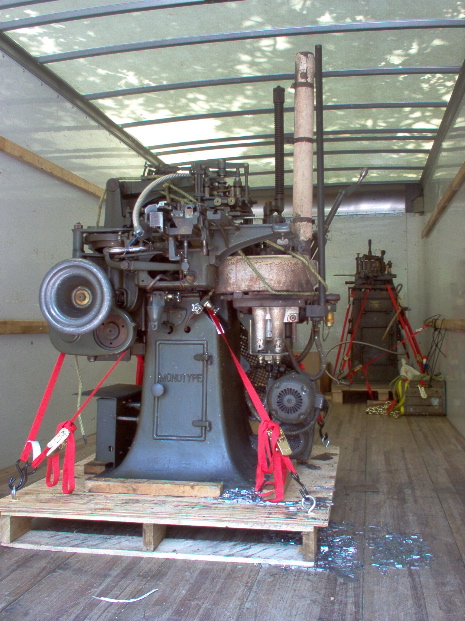
Here are the facts behind the previous entry, which was rather oblique and glorified because of my excitement:
Some two years ago I acquired a ‘Monotype’ Composition Caster – a machine that automatically casts individual printing types from molten metal and sets this type into justified lines, ready for printing. By automatically, I mean that the operation of the machine is controlled by a punched paper tape whose perforations are created by an entirely separate keyboard. For the printer, typographer or general enthusiast of machinery, a running ‘Monotype’ Caster is an amazing thing to witness.
I have had a great interest—okay, obsession—with these machines for several years. This passion culminated in my attending Monotype University 5, where I first met the amazing Mr Paul Duensing, from whom I acquired my first machine. Unfortunately, this caster was damaged in shipment! It took two years for me to fully recover from this minor tragedy and to locate a similar machine.
Finally, this spring…
Finally this spring, a similar, though slightly more worn out composition caster emerged at Heritage Printers, in Charlotte, North Carolina, under the care of Pat Taylor. As it happens, Pat Taylor was my tutor on the Monotype Composition Caster at Monotype University, so it seems fitting that I should acquire this ‘new’ machine from him.
With the expert help of Bill Welliver, the new caster made it safely back to my shop in Lititz, PA, where it has been lavished with preparations for its new assignment. In order to be fully operation at The Private Press of Ian Schaefer, the caster requires these accomodations:
- 3-phase power to the 3/4 hp motor – this will probably be provided by a variable frequency drive, which should allow finer adjustment at low speed settings.
- Propane gas to power the melting pot – the pot was previously feed by natural gas, which means that the burner orifices must be reduced, probably by soldering and re-drilling an even smaller hole.
- Water coolant – my shop has no nearby water supply, so the casting machine moulds must be cooled by a recirculating water system. I plan to start building a unit based on the model designed by Jim Walczak, and presented at the 2004 ATF Conference.
- Air power to control the machine at a steady 15 psi – this one is easy: I already have a very serviceable compressor.
I intend to document the progress here, along with photos of the ‘Monotype’ Caster and the entire shop.
Before I started my apprenticeship (1964) as a Hand Compositor, at Fleet Composition, in Sydney Australia, I operated a supercaster then a caster. Fleet Composition was a ‘tradehouse’ that supplied type from the supercaster and finished jobs from the caster, to small printers in Sydney and Norfolk Island.
I still have a 10pt monotype caracter with thw Lords Preyer etched onto it, with the bottom line “Monotype Corporation”. In the late 1990’s I obtained a case of Dorchster Script in 14pt Foundry Type (with the round nick in the body of the type.)
There are ‘fond’ memories. It was very noisy in the caster room. Three casters and two supercasters. While operatinf the casters, I can remember when you had a ‘squirt’, especially when someone was walking by, they never appreciated the operator wasn’t trying to ‘get’ them.
Fond memories of starting a 6.00am in the morning. Turning on the gas pots and the electric pots, and cleaning the space bars of the Linotype machines (3) with graphite powder — epecially in winter.
Ah, those were the days.
Keep up the good work.
Former Monotype Owner had a 15 X 17 Composition Caster named Treaser Ann. Sold it in the early 1970’s. It was moved to servral locations prior to selling it. In the move several composition Moulds did not make the move till after we sold out. I think with a little cleaning, some tender loving care they will work quite well. They are located at in my barn in Lempster NH.
6pt 3E C1237 – 8pt 3E V133 – 10pt 3E C1237 – 10pt 3F C1284 – 11pt 3E431. It would be nice to find them a good home. Also have a pump cleaning brush and air line cleaning piston.
I can be reached at ny e-mail address or phone 603 863-6718.
hi there – i to am a qualified monotype caster minder mechanic – did a 5 year apprenticeship in the early seventies – ran casters and supercasters – we never used gas for the pots – we used electricity – my journey man was a guy name Ronnie Bland – he was a master craftsman – he also taught me how to master the supercaster to the point that we could cast one point rules by disabling the cutter to a length of about 12 feet without the rule snapping – apart from that we were taught to dis-assemble the machine to basic spare parts and then re-assemble them to fully understand the workings – i still have a 9 point mould and also a die case – if you are interested in having them – i still to this day would love to find one here in south africa – just to operate it for a while – to get the kick out doing something that i was trained for – but alas – has disappeared into the mists of time – would like to hear from you